Strawberries are not only appealing for their fruits but also exhibit intelligent growth strategies: They can extend laterally via stolons, rooting upon contact with soil to achieve asexual reproduction from “one plant to a patch”; alternatively, they can develop axillary buds into branches, increasing the number of flowers and fruits to enhance yield. This critical decision occurs in a cell cluster at the leaf axil known as the “axillary meristem”, where its differing developmental fates directly determine the strawberry plant’s architecture, reproductive capacity, and fruit production.
Recently, the collaborative team led by Chair Professor Zhongchi Liu from our Faculty and Professor Lei Guo from Shandong Agricultural University published a research paper in the international authoritative journal Molecular Plant titled “Integrative regulation of axillary meristem maturation and stolon fate determination in strawberry by light, gibberellin, and ZFP6”, systematically elucidating the regulatory mechanism of axillary bud development in strawberries. The study found that axillary bud maturation depends on red light signaling; upon maturation, buds can choose to develop into stolons or branch crowns, and the zinc finger protein transcription factor ZFP6 was identified as the key factor initiating stolon formation. This achievement not only deepens the theoretical understanding of plant morphogenesis but also provides new insights for strawberry asexual reproduction and variety improvement.
Research Background: The Fate of Axillary Buds Shapes Plant Architecture
Plant architecture not only concerns environmental adaptation but also directly relates to cultivation management convenience, final crop yield, and even ornamental value. Among these, the growth point at the leaf axil (axillary meristem) plays a central role. It acts like a “stem cell factory” with multiple potentials, capable of developing into lateral branches, tendrils, flowers, or—in strawberries—stolons or branch crowns, or remaining dormant under different plants or conditions (Figure 1). This flexible fate decision endows plant architecture with strong plasticity. However, the molecular mechanisms directing this “factory” to make different choices have long remained unclear.
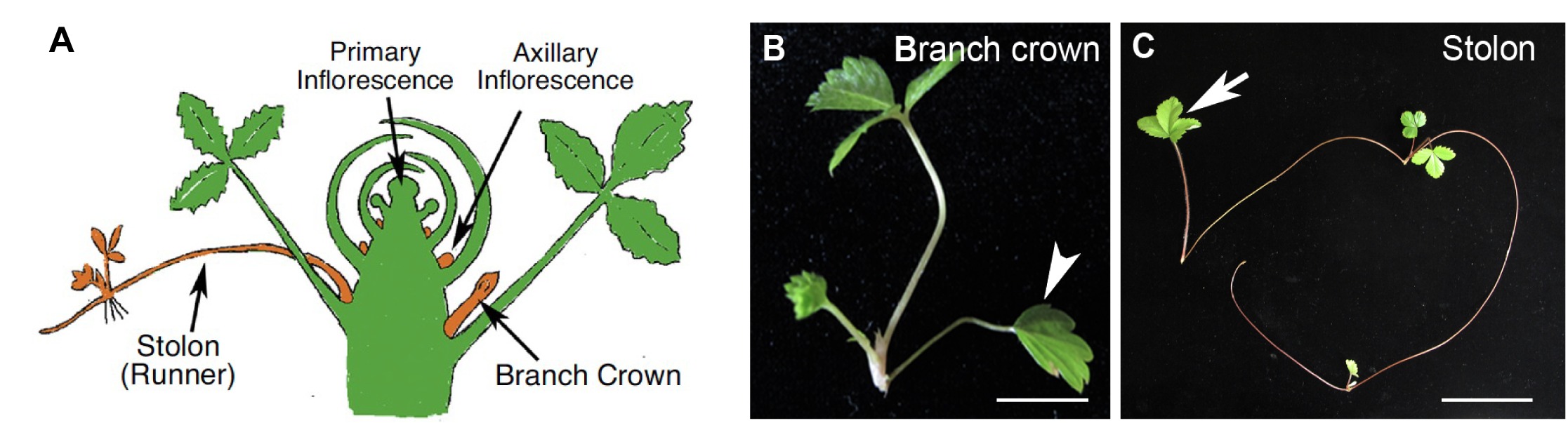
Figure 1: Branch crown and stolon are two mutually exclusive lateral organs formed by the development of axillary meristem in woodland strawberry
Research Content: Light Signal “Matures”, ZFP6 Gene “Decides”
The research team discovered that as strawberries transition from juvenile to adult stage, a key transformation occurs in the growth point at the leaf axil (axillary meristem): A gene named GA20ox4 is “activated”, beginning to synthesize growth-promoting gibberellin, thereby initiating stolon formation.
To identify the upstream command controlling this “switch”, the team conducted in-depth gene analysis and ultimately pinpointed a key protein—ZFP6, acting like a commander specifically issuing orders to “produce stolons”. When scientists used CRISPR gene editing to “knock out” ZFP6, the GA20ox4 gene was completely silenced, and the zfp6 mutant no longer produced any stolons (Figure 2). However, supplementing gibberellin to the zfp6 mutant restored stolon growth. This proves that ZFP6 directs stolon development precisely by activating gibberellin synthesis (Figure 3).
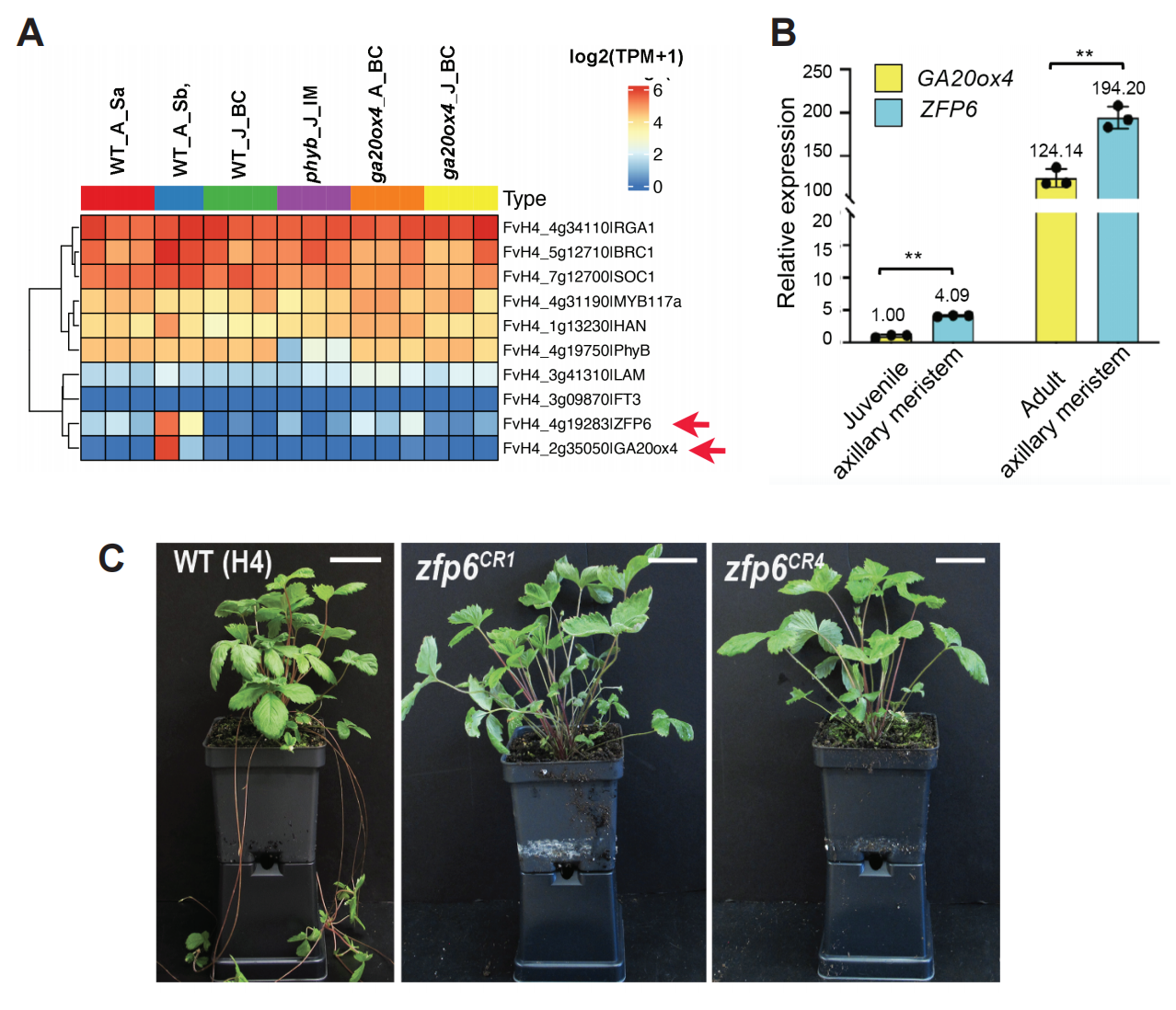
Figure 2: ZFP6 is co-expressed with GA20ox4 and is an essential regulatory factor for stolon formation
Additionally, the study systematically mapped the complete “roadmap” of axillary bud development, dividing it into four sequential stages: Initiation: initial formation of the growth point; Maturation: acquisition of developmental potential by the growth point (a key stage first explicitly proposed in this study); Fate determination: choosing to develop into stolon or branch crown at this point; Differentiation: growing into the corresponding organ according to the decision (Figure 3).
The study found that red light signaling and its receptor PhyB are key environmental signals driving the growth point from “initiation” to “maturation”. Throughout the process, environmental signals (such as light) and plant hormones (such as gibberellin) perform their respective roles at different stages, working synergistically to finely regulate the ultimate fate of axillary buds.
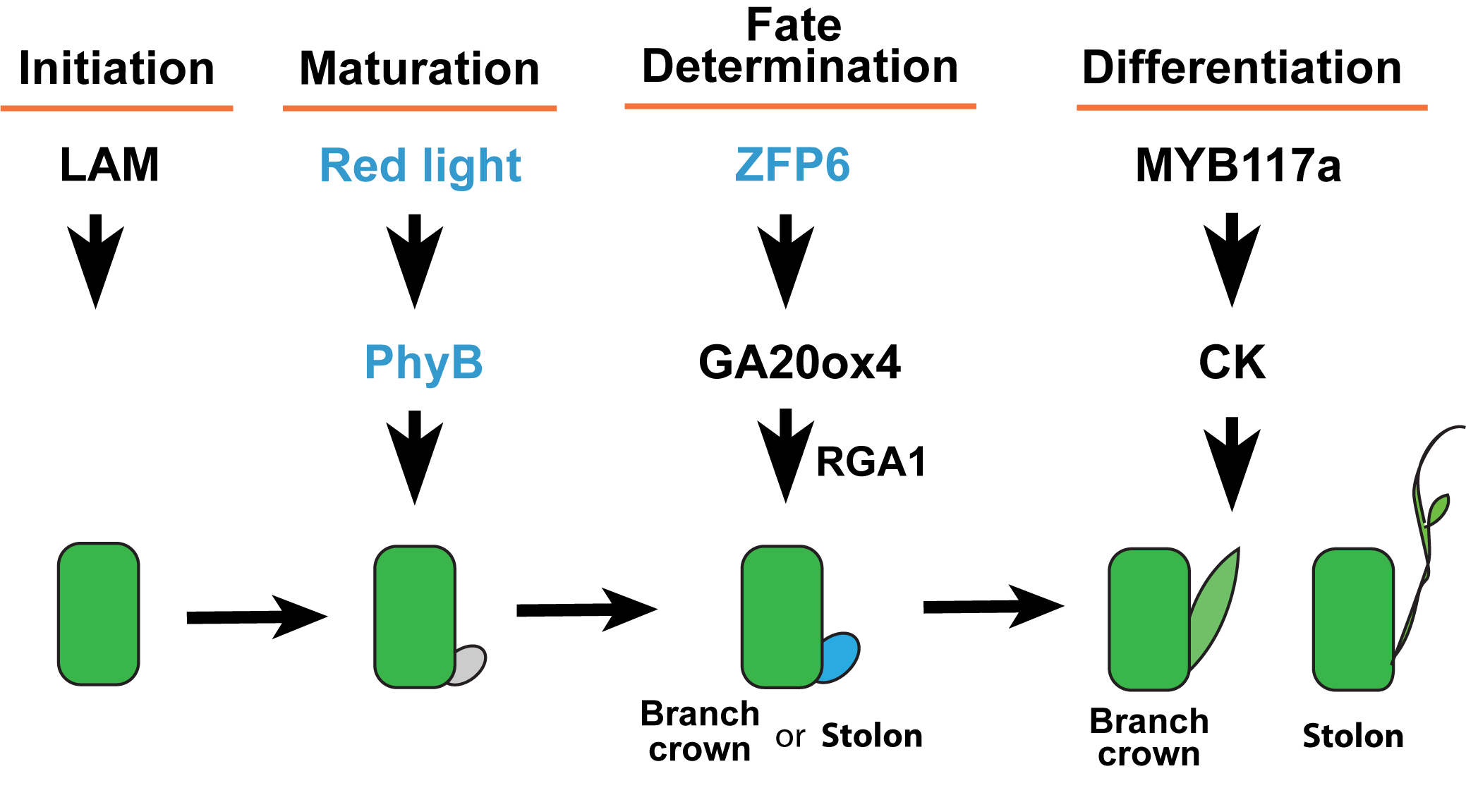
Figure 3: The development process of strawberry axillary meristem involves four distinct stages, each mediated by different regulatory factors. Blue highlights indicate factors emphasized in this study.
Research Conclusions: Integrated Regulatory Network of Signals and Hormones
This study integrated multidimensional information including developmental stages, light signals, and plant hormones, mapping a detailed “regulatory blueprint” for lateral bud development in strawberries and identifying two core nodes:
1.Light as “Maturation Signal”: Red light and its receptor PhyB are essential conditions for enabling the growth point at the leaf axil (axillary meristem) to acquire developmental potential.
2.ZFP6 as “Fate Switch”: The zinc finger protein ZFP6, specifically expressed in adult strawberries, was identified as the key factor determining lateral bud fate. It acts like a precise genetic switch, initiating stolon formation by directly activating the expression of the gibberellin synthesis gene GA20ox4.
This achievement not only deepens the theoretical foundation of plant lateral bud development but also provides new possibilities for crop architecture design. In the future, by precisely regulating this network, we hope to breed new varieties of strawberries and other crops that are more environmentally adaptive, easier to manage, and higher yielding, offering new strategies and possibilities for modern agricultural breeding.
Research Team
This study was led by Professor Zhongchi Liu as the corresponding author; Professor Lei Guo (former postdoctoral fellow at the University of Maryland, currently Professor at Shandong Agricultural University) served as the first author and co-corresponding author, making major contributions. Additionally, participating researchers include Dr. Muzi Li (former PhD student at the University of Maryland, currently postdoctoral fellow at Shenzhen University of Advanced Technology), Professor Xi Luo (former postdoctoral fellow at the University of Maryland, currently Professor at Shandong Agricultural University), graduate student Ning Ma (Shandong Agricultural University), Professor Shaojun Tang (Hong Kong University of Science and Technology), and graduate student Tianlong He. This research was primarily supported by the U.S. National Science Found



 Address: No. 1 Gongchang Road, Guangming District, Shenzhen
 Tel: 0755 8880 2424
 Email: synbiofaculty@suat-sz.edu.cn
 Postal Code: 518107