On June 17, 2026, Professor Zhenbiao Yang’s team from the Faculty of Synthetic Biology at Shenzhen University of Advanced Technology published an article entitled “Agrobacterium tumefaciens-derived cytokinin induces the transdifferentiation of pavement cells to trichomes in tobacco leaves” in the esteemed plant science journalPlant Communications. This study provides the first evidence that Agrobacterium-derived cytokinin can directly “awaken” fully differentiated plant epidermal cells, driving their transdifferentiation into high-value specialized “cell factories”—glandular trichomes. This breakthrough circumvents the biological constraints limiting glandular trichome abundance on mature leaves, thereby establishing a novel paradigm for the highly efficient and sustainable production of plant natural products.
A mature leaf resembles a highly organized industrial complex. The tightly interlocked pavement cells covering the leaf surface function like thefundamental structural architecture, maintaining the leaf’s morphological integrity. Scattered among them, glandular trichomes serve as specialized “chemical factories”dedicated to the biosynthesis, transport, and storage of commercially valuable secondary metabolites, such as artemisinin and cannabinoids.
Classical developmental paradigms generally conceptualize cell fate as a unidirectional trajectory:upon terminal differentiation, pavement cells retain a fixed identity and are traditionally considered incapable of transitioning into specialized secretory units.This developmentalrestriction on cell fate directly limits the production capacity of plant cell factories. Once a leaf matures, the density of glandular trichomes remains largely static,imposing a fundamental ceiling on the yield of secondary metabolites.
Yet one of the fascinating aspects of life science is that biological systems can sometimes defy conventional expectations.However, the intrinsic plasticity of biological systems occasionally challenges these established developmental dogmas.
A Serendipitous Discovery
The breakthrough originated from a routine experiment. While treatingNicotiana benthamianaleaves withAgrobacteriumstrain GV3101, researchers observed an unexpected phenomenon: regions treated with GV3101 exhibited a dramatic increase in glandular trichome density that was visible to the naked eye.
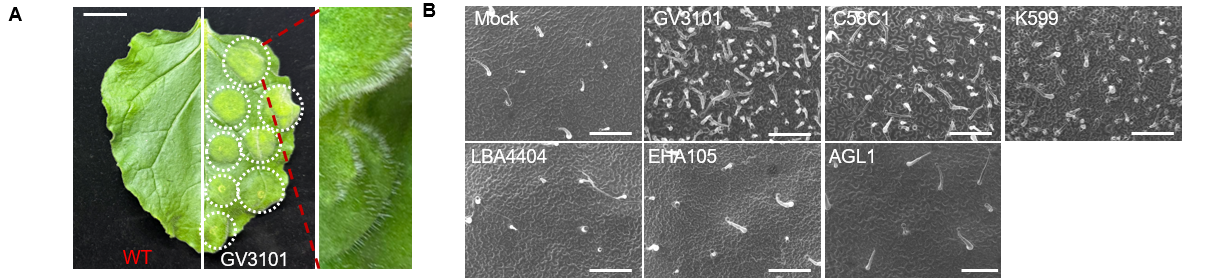
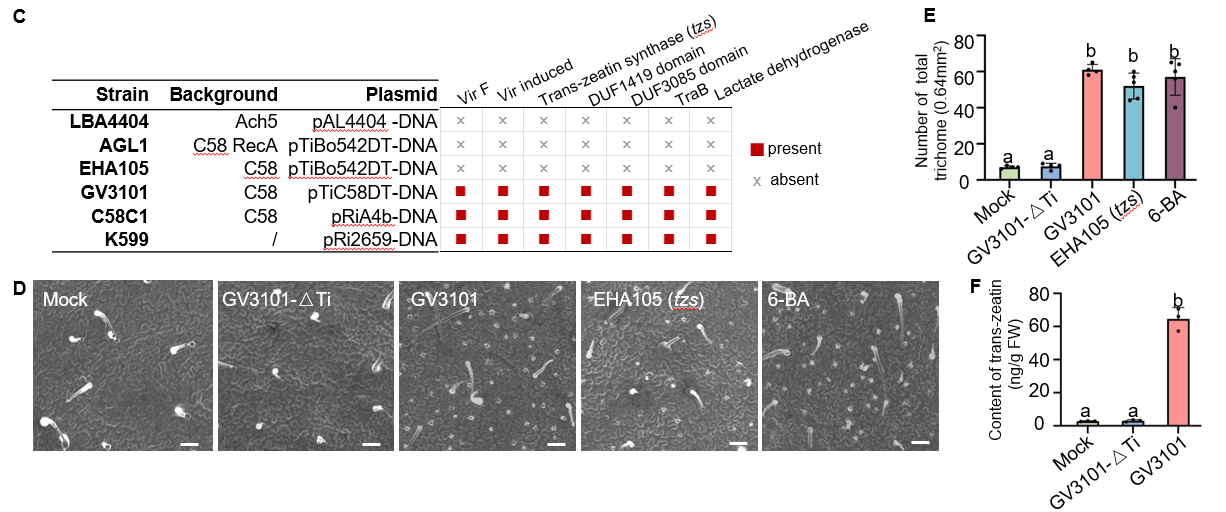
Subsequent investigations screening six widely utilized Agrobacterium strains demonstrated that this inductive capability was exclusive to strainsGV3101,C58C1, andK599.Genomic analyses elucidated that these functional strains uniquely harbor thetzs(trans-zeatin synthase) gene on their Ti plasmids, a locus absent in the non-inducing strains. Thetzsgene encodes an enzyme responsible for the biosynthesis of trans-zeatin, a specific cytokinin.This phytohormone functions as a molecular signal exogenously delivered by Agrobacterium to reprogram the developmental fate of tobacco leaf cells.
Compelling Evidence:Step-by-Step Validation To fully understand this process, the research team conducted a series of rigorous experiments.
·Multi-dimensional experimental validation:The researchers removed the Ti plasmid from GV3101,heterologously expressed the tzs gene in the non-inducing strain EHA105, and directly applied the cytokinin analog 6-BAdirectly to the leaves. Coupled with precise quantitative profiling of trans-zeatin via liquid chromatography-mass spectrometry (LC-MS), these experiments definitively confirmed thattzs-mediated cytokinin biosynthesis is the primary catalyst trigger cell transdifferentiation.
·High-resolution transcriptomic profiling:In their experimental design, researchers established fourdistincttreatment conditionsonNicotiana benthamianaleaves to capture molecular signatures associated with transdifferentiation. Transcriptomic analyses revealed that, after receiving the signal, the cells underwent extensive transcriptional reprogramming. Master transcriptional regulatorsgoverning glandular trichome specification, notablyTTG1,GL2, andMIXTA1, underwent significant upregulation, while genetic markers maintaining pavement cell identity, includingIQD21andCYCD1;1, were concurrently repressed.
·Morphological confirmation:Continuous scanning electron microscopy (SEM) observations showed that the the characteristically planar surfaces of mature pavement cells initiated outward protrusions, sequentially developing into mature glandular trichomes.Remarkably, within a nine-day post-infiltration, the number of glandular trichomes on mature leaves increased nearly tenfold.
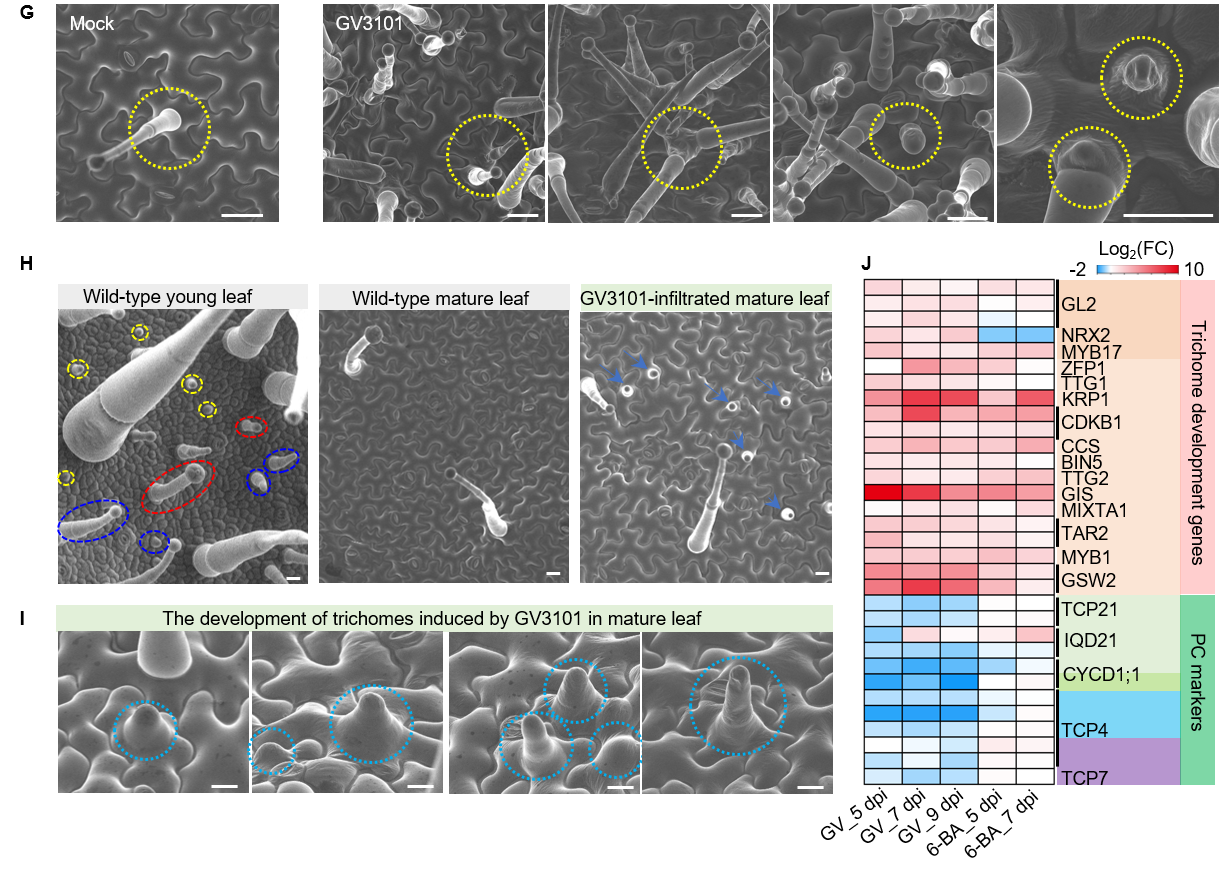
A critical revelation of this process is the directness of the cellular identity transition.Pavement cells did not need to first return to a stem-cell-like state through dedifferentiation. Instead, they achieved fate conversionin situvia direct transdifferentiation. This finding challenges the conventional view of the terminally differentiated status of plant epidermal cells.
From Mechanistic Insights to Future Biomanufacturing
While uncovering the plasticity of cell fate advances foundationalplantdevelopmental biology, its translational potential is highly significant. Synthetic biology has continuously sought more efficient chassis for producing plant natural productbiosynthesis. While Traditional approaches have focused on microbial engineering. plant cells natively possess specialized organelles and sophisticated enzymatic complexes that offer distinct advantages over microbial hosts. This study provides an innovative framework: if mature leaves can be reprogrammed through cytokinin signaling to continuously generate new glandular trichome "factories", it may become possible to precisely activate this process at specific developmental stages or in specific leaf regions through chemical induction or genetic engineering.
The authors highlight that this discovery not only expands our understanding of plant cell fate flexibility but also provides a promising platform for next-generation biomanufacturing. Translating this "factory expansion""concept into industrial-scale production necessitates subsequent optimization. Future endeavors willfocus onintegrating biosynthetic gene clusters encoding high-value compounds —such as pharmaceutical precursors and aromatic molecules—into thesede novogenerated glandular trichomes,and determiningwhether these newly established "production lines" can efficiently synthesize target products. Nevertheless, this discovery provides a potential “master key” for overcoming the limitation of glandular trichomedensity.
Ultimately, synergizing this induction technology with targeted biosynthetic pathways could elevate ordinary tobacco leaves into economically viable, highly scalable, and sustainable "biofactories" for elite natural products. The story of this leaf has only just begun.
Postdoctoral researcher Fengjiao Wang and Ph.D. candidate Jialin Liu from the Shenzhen Institutes of Advanced Technology, Chinese Academy of Sciences(SIAT), are co-first authors of the paper. Professor Shuang Wu(FAFU)and Associate Researcher Xiang Zhou(SIAT)provided valuable suggestions for the study. Research Assistant Yunyun Shi from Shenzhen University of Advanced Technology(SUAT)participated in the project. Professor Zhenbiao Yang and Distinguished Associate Professor Lingling Ye fromSUATare co-corresponding authors. This research was supported by the National Natural Science Foundation of China, the Guangdong Innovation Team Project, startup funding from Shenzhen University of Advanced Technology, and the National Key Research and Development Program.
Link:https://www.sciencedirect.com/science/article/pii/S2590346226002786?sessionid=



 Address: No. 1 Gongchang Road, Guangming District, Shenzhen
 Tel: 0755 8880 2424
 Email: synbiofaculty@suat-sz.edu.cn
 Postal Code: 518107