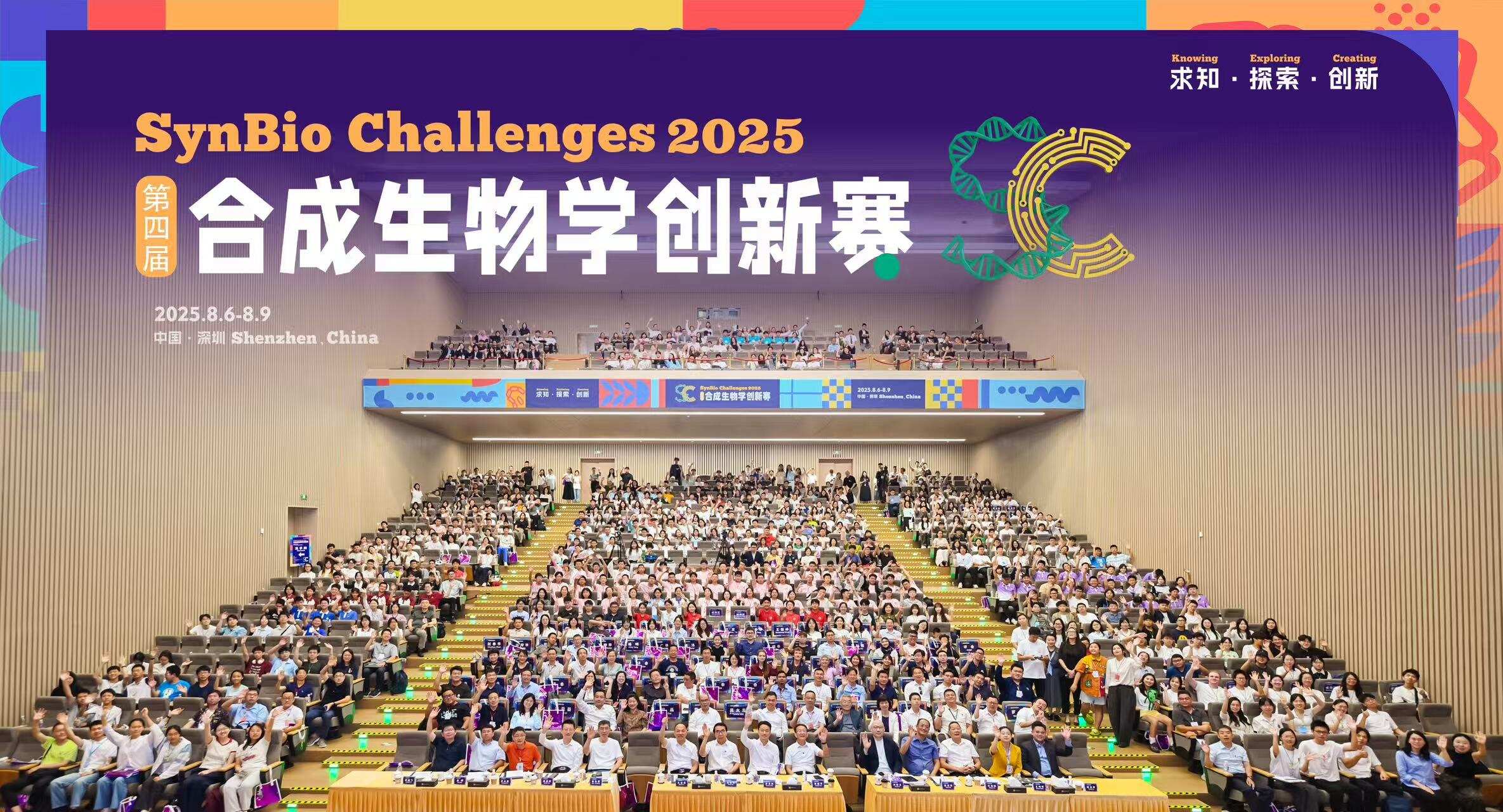
From August 6 to 9, the 4th SynBio Challenges was successfully held at Shenzhen University of Advanced Technology (SUAT). The event was hosted by the Chinese Society of Biotechnology and co-organized by SUAT, Shenzhen Institutes of Advanced Technology (SIAT), Chinese Academy of Sciences, the Shenzhen Institute of Synthetic Biology, the Shenzhen Synthetic Biology Association, and the National Industrial Innovation Center for Bio-manufacturing (NIICB).
Adhering to the core philosophy of "Build to Learn, Build to Use", the competition attracted over 200 university teams and nearly1,900young talents from around the world. The finals brought together nearly 1,000 participants from six countries, including Japan, Russia, Singapore, Malaysia, Thailand, and China, with over 11 million engagements across global platforms, fully showcasing the brilliance of young synthetic biology talent.
The competition featured seven tracks: th eWhite Trackfocused on industrial applications, the Green Track covered agriculture and the environment, the Red Tracktargeted health and medical treatment, the Bacterial Gladiator Trackutilized gene editing to manipulate microorganisms for strategic competition, the Protein Design by AI Track leveraged machine learning models to optimize protein functions, the Synthetic Cell Track focused on foundational technologies for creating life from scratch, and the Socially Responsible Innovation In Life Sciences Trackemphasized ethical safety risks and sustainability issues. Each track aligned closely with themes of public health, industrial transformation, and green low-carbon development, offering innovative solutions from the younger generation for global sustainability. Additionally, the event leveraged the support of Shenzhen Synthetic Biology Infrastructure and the leading advantages of future synthetic biology industries, actively promoting the integrated development of education, science, and talent.
In his address, Bai Chunli, Honorary Chair of SynBio Challenges, former President of the Chinese Academy of Sciences, and Academician, stated that following the discovery of the DNA double helix and human genome sequencing, synthetic biology is poised to spark the third biotechnology revolution. Its innovations deeply impact strategic fields such as healthcare, industrial manufacturing, modern agriculture, and green energy, injecting strong momentum into traditional industry upgrades and serving as a core engine for fostering new productive forces in bio-manufacturing.
SUAT President Fan Jianping noted that amid the dual opportunities of technological revolution and industrial transformation, the deep involvement of young innovators is urgently needed. As a new research-oriented university, SUAT benefits from the region's vibrant innovation and thriving emerging industries, providing an ideal environment for faculty and students to break through traditional research paradigms and pursue interdisciplinary frontier exploration. He encouraged students to "hypothesize boldly and verify rigorously", embodying the pioneering spirit of the special economic zone.
Liu Chenli, Director of the Shenzhen Institutes of Advanced Technology (SIAT), Chinese Academy of Sciences, highlighted that this year's competition reached a record-high participation scale and achieved breakthroughs in internationalization. He expressed hope that students would transform laboratory innovations into practical solutions for real-world challenges through the SynBio Challenges platform.
Xian-En Zhang, Vice Chairman of the Chinese Society of Biotechnology, Chair of SynBio Challenges, and Dean of SUAT’s Faculty of Synthetic Biology, explained that synthetic biology, as a quintessential convergent technology and interdisciplinary field, holds significant scientific value and industrialization potential.He emphasized that SynBio Challenges will steadily advance its internationalization, develop its unique characteristics, and collaborate with the International Genetically Engineered Machine Competition (iGEM) to create a global synthetic biology ecosystem for young students, shaping the future of synthetic biology together. Finally, he encouraged young scholars to "compete with excellence, spirit, and camaraderie" in this scientific arena.
The participating projects in this year's competition covered diverse areas, including anti-aging recombinant collagen, super-phage therapy for drug-resistant bacterial infections, synthetic biology-based modification of the thiopeptide antibiotic nosiheptide, and the construction of engineered yeast for treatingHelicobacter pylori. The SynBio Challenges encouraged teams to address the full spectrum from basic research to applied translation, emphasizing both the originality of scientific questions and cutting-edge technologies and the feasibility of technical solutions. The competition aims to promote synthetic biology research outcomes that effectively serve societal development needs.
The award winners were announced on the afternoon of August 8. The Zhejiang University ZJU-China team won the SynBio Challenges Grand Prize. Addressing technical bottlenecks in water pollution monitoring, the team integrated synthetic biology with intelligent equipment technology to develop an ultra-high-sensitivity biosensing system. By leveraging allosteric transcription factor sensors and light-controlled protein factories, this system enables real-time pollutant monitoring and simultaneous degradation, providing a next-generation solution for water environment safety.
Other teams also delivered outstanding performances across various tracks. Ultimately,Xiamen University's Organelle Wholesale Team won the Best Industrial Award in the White Track, Zhejiang University's ZJU-China team won the Best Environmental and Agricultural Award in the Green Track, and Beihang University’s Synthetic Probiotics Team won the Best Health and Medical TreatmentAward in the Red Track.
In the Bacterial Gladiator Track, Nanjing Agricultural University's Wild Growth Team won theBest Bacterial Gladiator Award.In the Protein Design Track,the Best Brightness Awardwas shared by Beijing Institute of Technology's Beidan Nanshu Team, South China University of Technology's SCUT-ProteinX Team, and The National University of Malaysia's IGNITE UKM Team.The Best Thermal Stability Awardwas awarded to Beijing Institute of Technology's Beidan Nanshu Team, South China University of Technology's SCUT-ProteinX Team, and Suranaree University of Technology's GreenShifters Team from Thailand.
In the Synthetic Cell Track, Hubei University's Microbe HUT Team won the Best Synthetic Cell Award. The Ai for bio.LIMPID Team, composed of members from Dalian University of Technology, University of Pittsburgh, and KU Leuven, won both the Best Socially Responsible Innovation In Life Sciences Award and the Best Presentation Award. Additionally, the Army Medical University's AMU-China Team received the Best Science Popularization Award, and the Navy Medical University’s Synth NK Team won the Most Popular Award.
Wang Li, Deputy Secretary of the Party Committee and General Manager of Moutai Group, the exclusive partner of SynBio Challenges, stated that the encounter with synthetic biology represents a timeless connection within biotechnology. Moutai is committed to building platforms to support the growth of young talents. Representatives from industry leaders such as China Resources Research Institute of Science and Technology, Weiguang Bio, and Bloomage Biotech, as well as international organizations like the iGEM Foundation, attended to support the event.
On the eve of the opening ceremony, a special lecture on bio-art was introduced. During the opening ceremony, the Shenzhen Institute of Synthetic Biology inaugurated the "Cross-Media Lab for Synthetic Biology and Art", fostering interdisciplinary fusion between life sciences and artistic creation to continuously spark innovation.
At the closing ceremony, Yi Xiao, a member of the SynBio Challenges expert committee and technical advisor, as well as a researcher at the Shenzhen Institutes of Advanced Technology (SIAT), Chinese Academy of Sciences, announced the establishment of the "SynBio Challenges Industry Expert Database". This database will serve as a key support platform, introducing a special "Industry-Driven Problem Solving" track in the next competition, providing young students with a direct channel to address real-world industry needs through innovative practice.
SynBio Challenges is dedicated to building a sustainable platform for creativity and innovation. By fostering an open and inclusive international competition ecosystem, it aims to continuously stimulate original innovation, promote cross-disciplinary collaboration, and drive the translation of technological achievements into real-world productivity, contributing youth-driven solutions and Chinese wisdom to sustainable societal development.



 Address: No. 1 Gongchang Road, Guangming District, Shenzhen
 Tel: 0755 8880 2424
 Email: synbiofaculty@suat-sz.edu.cn
 Postal Code: 518107